

The Constraint Moved Again

Every technological revolution runs into a physical constraint eventually. Capital can solve one layer, but that just exposes the next one underneath it. The semiconductor series documented that pattern at the fabrication layer - this piece follows it to where it moved next.
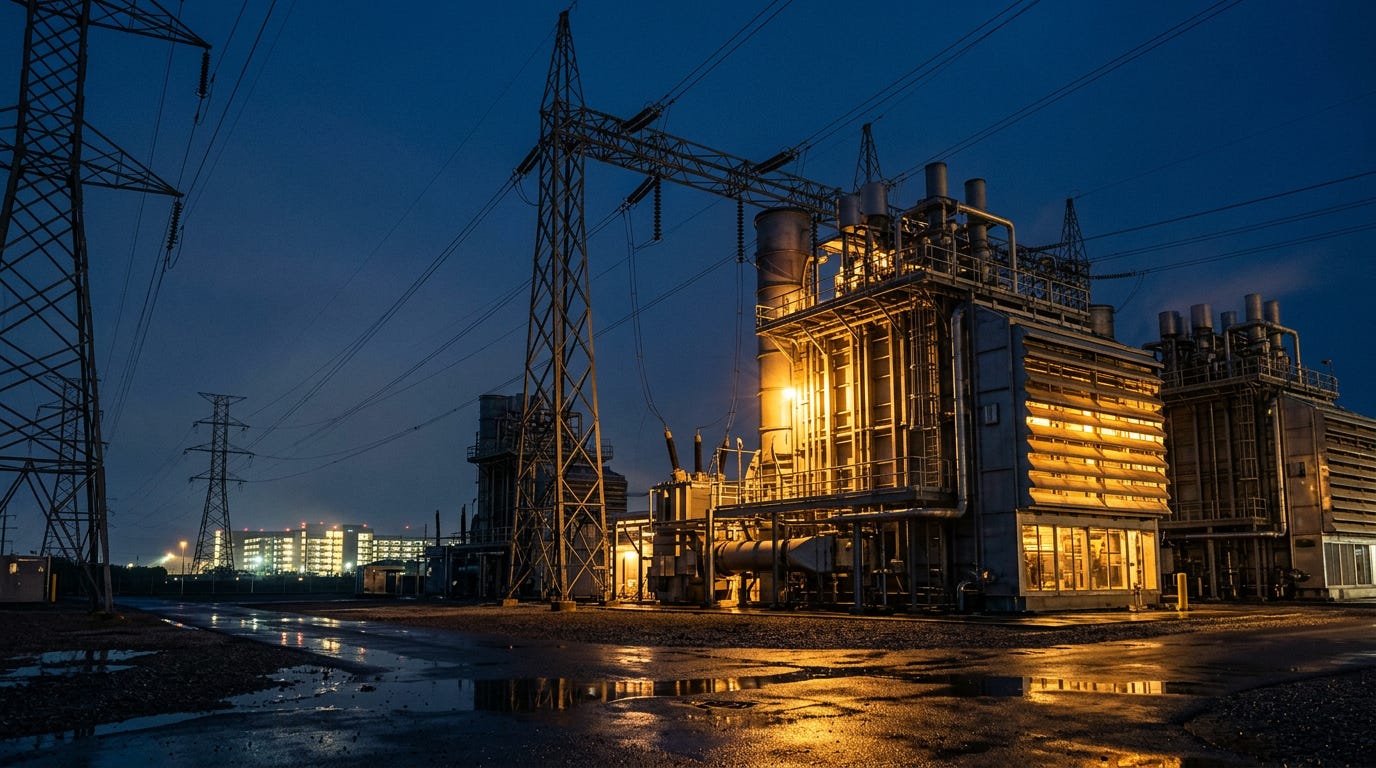
Homer City, Pennsylvania used to be home to the largest coal-fired power plant in the United States. It’s now being rebuilt as the largest gas-fired power station in the country (seven GE Vernova turbines producing up to 4.4 gigawatts) feeding a 3,200-acre data center campus on the same transmission lines the coal plant used. The transmission capacity already existed. The scarce asset was generation, not wires.
The turbines took three years to get.
That gap - between how much power AI data centers need and how fast anyone can actually build it - is what this piece is about. Not because the AI buildout is slowing. It isn’t. The physical layer underneath it just hasn’t caught up yet.
The Same Mechanism, A Different Layer
The deeper you move into the stack, the fewer substitutes exist and the longer the timelines become. Policy can subsidize factories. It cannot accelerate qualification.
That framework applies to power with the same precision it applied to chips.
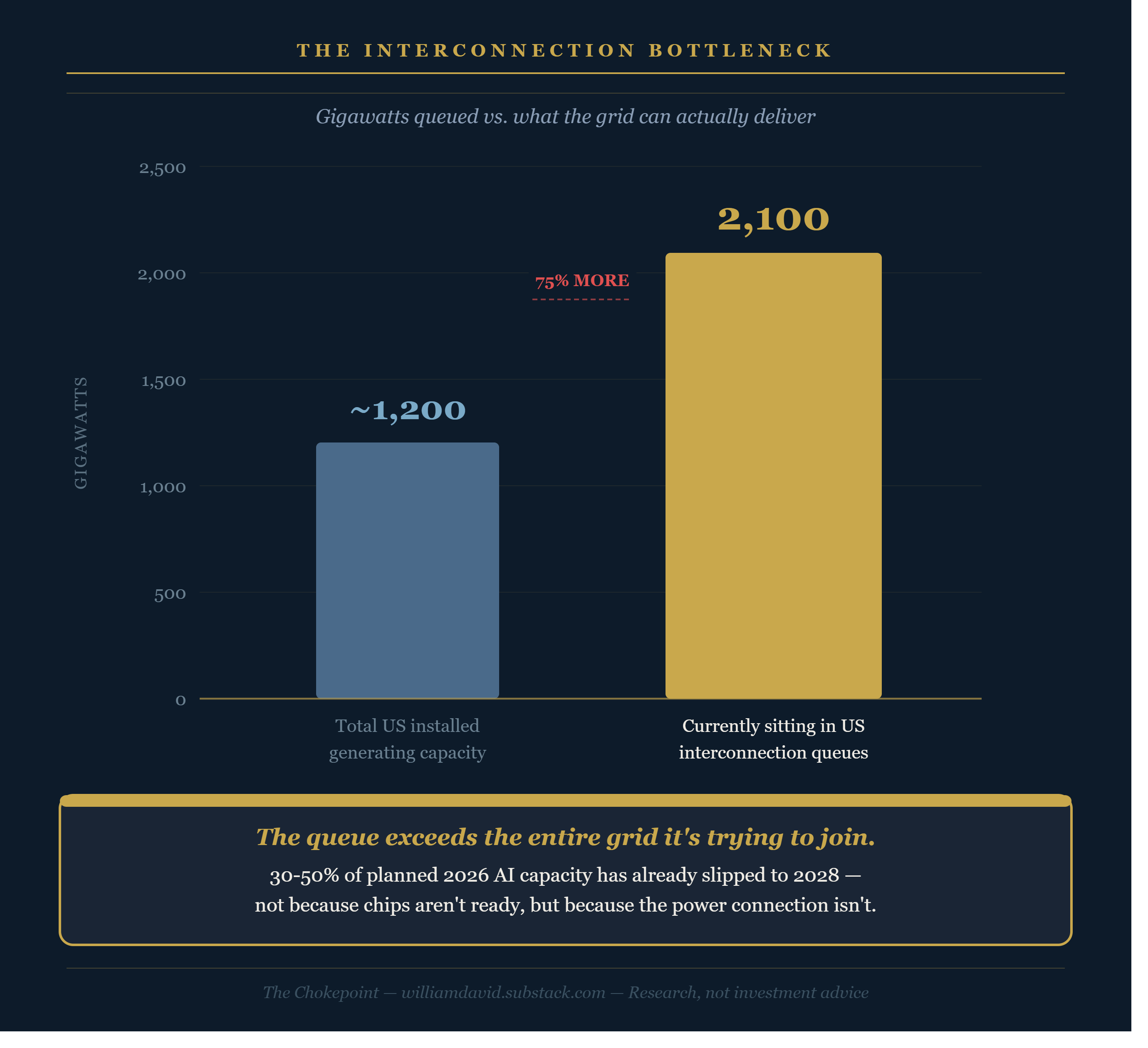
2,100 gigawatts currently sit in US interconnection queues - more than the total installed generating capacity of the entire US grid. Somewhere between 30 and 50 percent of planned 2026 AI data center capacity has already slipped to 2028 - not because the chips aren’t ready, but because the power connection is. Interconnection rights - the legal permission to connect a facility to the grid and draw firm, reliable load - are the scarce asset that capital alone cannot manufacture on a political timeline.
Washington already tried to fix this. In April 2026, grid infrastructure was designated a national defense priority under the Defense Production Act - the kind of move meant to fast-track exactly this problem. It’s the right call. But transformers still take more than two years to deliver, because policy can order urgency and still can’t manufacture the supply chain that urgency requires.
The law arrives before the thing it requires.
The Bypass and Its Own Constraints
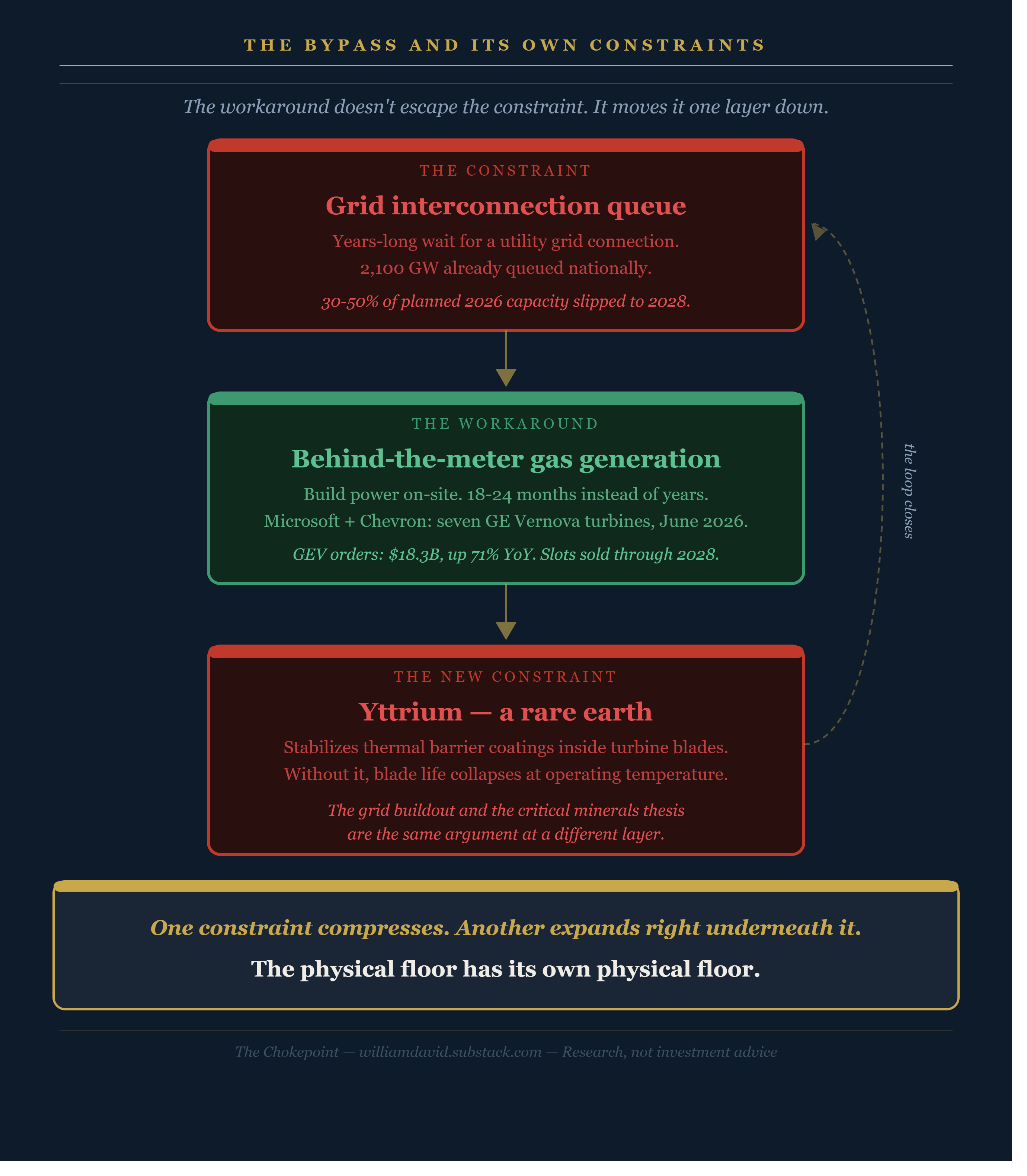
If you can’t get a grid connection for years, the obvious move is to build your own power instead. That’s what behind-the-meter gas generation is - a power plant built right on-site instead of waiting on the utility grid - and it can be up and running in 18 to 24 months instead of years. Microsoft did exactly this in June: seven GE Vernova turbines for a Texas data center, built alongside Chevron. Homer City isn’t an isolated case. It’s the template everyone else is now following.
The order book already shows how fast this is moving. GE Vernova’s first quarter 2026 orders made the demand explicit: $18.3 billion, up 71% from a year earlier, with data center electrification orders in a single quarter exceeding all of 2025. Gas turbine backlog and slot reservations grew from 83 to 100 gigawatts in one quarter, prices are up 300% over three years, and available slots are already sold through 2028, with 2029 now under negotiation.
But the bypass has its own physical constraints. This is where the framework reasserts itself one layer deeper.
Gas turbines require yttrium. Specifically, yttrium oxide - which stabilizes the thermal barrier coatings inside turbine blades (the ceramic layer that allows components to operate at temperatures exceeding their own melting points). Without it, blade life collapses. Yttrium is a rare earth. The grid buildout and the critical minerals thesis are the same argument running at a different layer of the same stack.
The physical floor has its own physical floor.
The Materials Underneath
Copper runs through every layer of this buildout, more of it than most AI infrastructure models seem to have priced in. Bank of America estimates 60 to 75 tonnes of metal per megawatt of AI data center capacity - at 200 gigawatts by 2030, that’s 12 to 15 million tonnes of metal for data centers alone, over four years.
But copper’s constraint is not a story AI created. AI arrived while transportation, electrification, defense, and the energy transition were already competing for the same conductor. The US currently supplies roughly 86% of its own copper needs. By 2035, BloombergNEF projects that figure falling to 62% as demand compounds across every industrial buildout simultaneously. AI is not creating a new demand curve. It is colliding with every existing one at once.
Engineers are already trying to design around the copper problem, and it’s worth understanding why their fix doesn’t actually make the constraint disappear. AI data centers are shifting to 800-volt DC power, because higher voltage means less copper is needed per circuit. But that same shift deepens dependence on gallium nitride, a compound semiconductor used in the power conversion systems that make high-voltage distribution work in the first place. So the engineering solves one constraint and quietly creates another - less copper, more gallium nitride. That’s the pattern worth watching throughout this piece: one constraint compresses, and another expands right underneath it.
The transformer constraint is where this lands most visibly today, with delivery times now running above two years. Grain-oriented electrical steel - the specialized magnetic material inside every transformer the buildout requires, which allows electricity to be stepped up or down in voltage without excessive heat loss - has effectively one domestic integrated producer. Policy mandates domestically built grid infrastructure. The supply chain for the steel inside that infrastructure is not ready at the required scale.
Every Layer Becomes Industrial Capacity
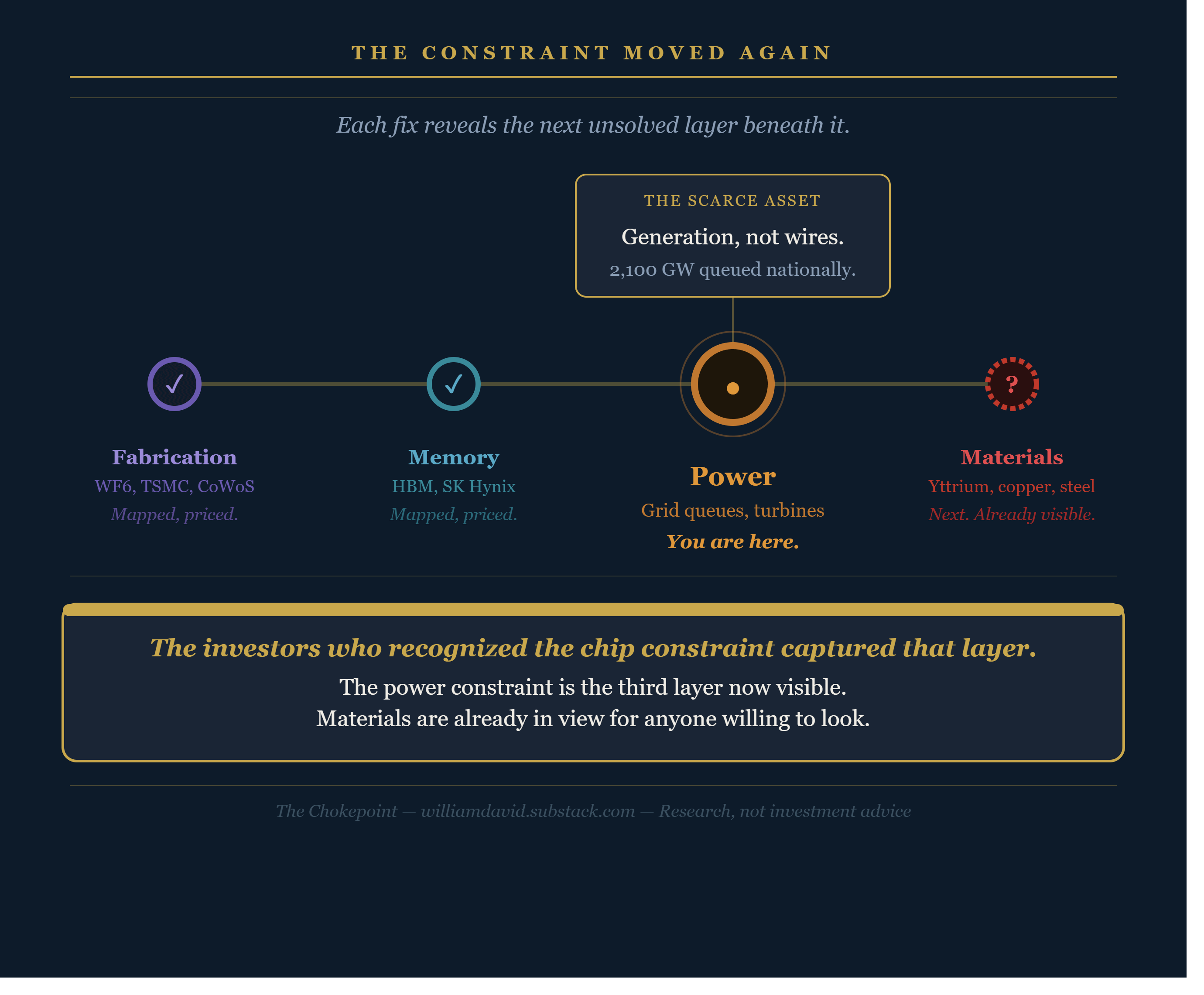
Step back from the individual constraints and look at what they add up to. Chips ran into fabrication capacity. Fabrication ran into memory. Memory is now running into power, and power is running into the materials and industrial base needed to build it out. Each fix reveals the next unsolved layer beneath it, and every layer eventually becomes the same kind of problem - not software, not capital, but industrial capacity, with timelines measured in years and constraints that intent alone cannot compress.
The investors who recognized the chip constraint early captured the first layer of that value. The investors who recognized the memory constraint captured the second. The power constraint is the third layer now visible. Below it, already in view for anyone willing to look, are the materials and the industrial capacity to produce them.
The deepest constraints carry the longest timelines, the fewest substitutes, and the most durable pricing power.
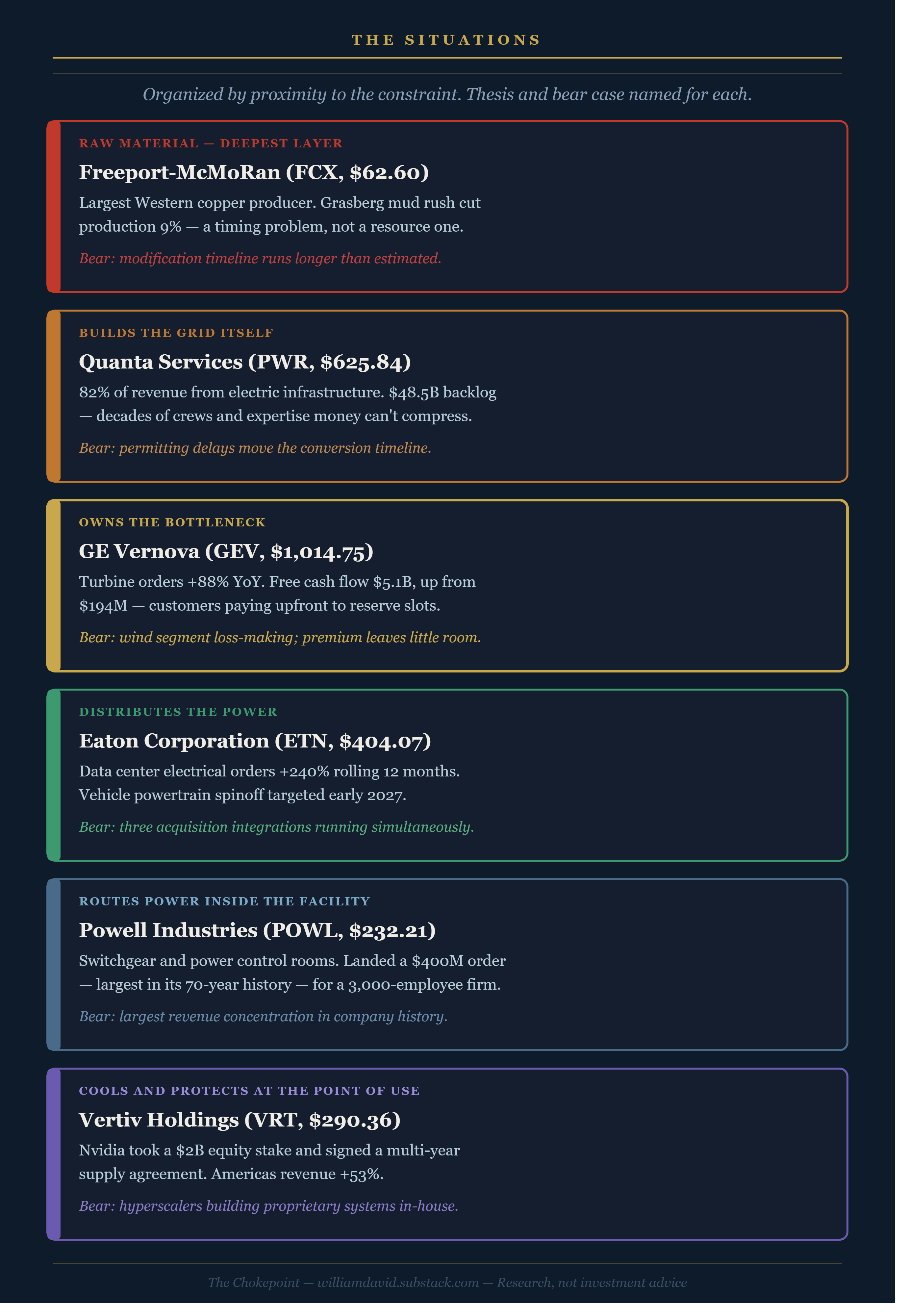
The Situations
The framework identifies the gaps. The companies below sit inside them.
The question is not who benefits from the AI buildout, because nearly everyone in the stack benefits from the boom. The question is who benefits from the gap between the constraint and the resolution (the period between when the problem is visible and when the supply chain can actually address it). That gap is where pricing power concentrates.
The situations below are organized by proximity to the constraint itself.
These are not recommendations. The thesis and bear case for each is named. The reader decides.
POWELL INDUSTRIES (POWL, $232.21 as of July 24, 2026)
Start here, because most coverage does not.
Powell makes the equipment that sits between where the transformer ends and where the data center’s internal power begins - switchgear, power control rooms, electrical houses. It’s the layer that disappears inside the building the moment it’s installed and stays invisible until something goes wrong. Most people covering AI infrastructure have never written about it - it doesn’t show up in the GPU story or the power story, only in what connects them.
Every hyperscaler that builds behind-the-meter generation to avoid the interconnection queue still needs Powell’s equipment to route that power through the facility once it’s on-site. The bypass that avoids the grid doesn’t avoid Powell - it creates Powell’s order book.
The numbers back it up. New orders came in at $490 million last quarter, nearly double the prior year, and backlog reached $1.8 billion, up 33%. For every dollar of work completed, Powell signed $1.70 in new contracts, and the balance sheet carries no debt and $545 million in cash.
After the quarter closed, Powell landed a data center order exceeding $400 million - the largest in the company’s 70-year history. The company has roughly 3,000 employees. That order alone exceeds what a full year of prior quarterly revenue would suggest is manageable at their historical scale. They are going to have to grow into it.
At $232.21, the stock has pulled back roughly 29% from its all-time high of $328 while the order book has grown materially. Backward-looking, it looks expensive. Forward-looking - at what the next two years of backlog conversion implies - the picture is materially different. That is where the situation lives.
Bear case: Powell’s historical base was oil and gas, LNG terminals, and utilities. Data center is newer territory. The $400 million order is the largest single revenue concentration in company history. A delivery miss or cost overrun on a project of that scale - new territory for an organization of this size - lands hard on a stock priced for continued execution.
GE VERNOVA (GEV, $1,014.75 as of July 24, 2026)
GEV is the company that actually owns this bottleneck. Every hyperscaler that can’t get a grid connection needs a gas turbine instead, and at the scale this buildout requires, those turbines come from a short list of suppliers. GEV sits at the top of that list.
The most telling number in the second quarter print wasn’t the headline growth - it was who’s paying for what, and when. Orders came in at $24.2 billion, up 88% year over year, on revenue of $11.1 billion, up 22%. Gas turbine slot reservations grew from 100 to 116 gigawatts in a single quarter, with the company now targeting 125 gigawatts by year-end and backlog reaching $176.3 billion. But the number that actually matters is free cash flow: $5.1 billion, up from just $194 million a year earlier. That jump happened because hyperscalers are paying upfront to reserve turbine slots before the equipment even exists. That’s not a projection about future demand. That’s customers putting cash down today because they’re worried about not having a slot tomorrow.
Here’s what to watch in the next print: gas turbine orders in gigawatts. If bookings keep pace with the current run rate, that upfront cash keeps confirming real demand. If they slow, it means front-loading has outrun GEV’s ability to actually add production - a natural ceiling, since most capacity through 2030 is already spoken for.
The stock is up roughly 49% year-to-date and trades at more than double the sector average on forward earnings. That premium is really just the market agreeing GEV owns the physical constraint. The real question is whether the valuation already assumes the backlog converts at these higher prices - or whether there’s still room if it does.
Bear case: the wind segment is running at an operating loss guided around $400 million for the full year. It drags on overall profitability and competes with the stronger segments for management attention. A deceleration in backlog conversion timing would test a premium valuation that leaves limited room for disappointment.
EATON CORPORATION (ETN, $404.07 as of July 24, 2026)
If GEV generates the power, Eaton is the company that manages it once it exists - switchgear, circuit breakers, power distribution units, the equipment that takes high-voltage power and routes it safely to wherever it’s actually consumed. Every new behind-the-meter power source needs Eaton’s equipment before a single server in the building can draw from it.
Revenue was strong in the first quarter - a record $7.45 billion, up 17%. But that’s not the number worth paying attention to. The number that actually stops you is what’s underneath it: electrical orders from data center customers in the Americas were up 240% on a rolling twelve-month basis. Revenue tells you what already happened. Orders tell you what’s coming.
There’s also a catalyst the stock hasn’t fully priced in yet. Eaton is spinning off its vehicle powertrain business into a separate company, targeted for early 2027. What’s left behind is a cleaner, more focused electrification and power management business - data centers, grid infrastructure, aerospace power systems. Other industrial companies that have done similar separations have generally seen the remaining high-growth business re-rate once investors stop averaging it against a slower-growth segment. Whether that happens here, and when, is really what the current valuation is trying to price in.
Bear case: first quarter operating margins declined slightly, driven by integration costs across roughly $11 billion in acquisitions completed in a single quarter. Management targets significant margin improvement in the second half. Executing three major integrations simultaneously while the separation is underway is a lot to ask of any organization.
VERTIV HOLDINGS (VRT, $290.36 as of July 24, 2026)
Everyone else in this piece is focused on generating power or moving it. Vertiv is focused on what happens once that power is already inside the building. It makes the cooling systems that pull heat out of servers running at maximum load, the power protection systems that prevent outages, and the power distribution infrastructure inside the facility itself - a different layer from GEV and Eaton, but the same constraint logic underneath it.
The number worth paying attention to isn’t the revenue - it’s who’s betting on Vertiv directly. First quarter revenue came in at $2.65 billion, up 30%, with the Americas up 53%, backlog above $15 billion, and full-year guidance raised. But the more significant signal happened outside the earnings report: NVIDIA took a $2 billion equity stake in Vertiv and signed a multi-year supply agreement. A customer that takes an ownership position is telling you it plans to stay a customer, not quietly build a competing solution in-house.
At $290.36, the stock has pulled back roughly 24% from its 52-week high of $379.93 while the fundamentals have continued to strengthen. It trades at roughly 73 times trailing earnings, which means the market is already pricing what comes next rather than what’s already happened - and the backlog and order trajectory either justify that premium or they don’t.
Bear case: if major hyperscalers move toward building proprietary cooling and power distribution systems at scale, Vertiv’s addressable market compresses. The NVIDIA relationship is the strongest evidence against this scenario. It is one relationship, not a structural guarantee.
QUANTA SERVICES (PWR, $625.84 as of July 24, 2026)
Not the turbines. Not the switchgear. Quanta builds the actual grid - the transmission lines, substations, and physical interconnection infrastructure that policy keeps mandating and the supply chain keeps struggling to deliver.
This isn’t a diversified contractor that happens to have grid exposure. It’s a grid company, full stop - 82% of its revenue comes directly from electric infrastructure. And the backlog shows just how far behind everyone actually is: $48.5 billion, roughly eighteen months of revenue at the current run rate, and still growing, because for every dollar of work Quanta completed last quarter, it signed $1.60 in new contracts.
That’s the moat, and it took decades to build - accumulated engineering expertise, specialized equipment, trained crews, established contractor relationships. You can’t compress that by hiring more people or spending more money in the short term. Quanta has built it over time, and the backlog reflects that scarcity.
At $625.84, down roughly 21% from a 52-week high of $788.75, the stock sits well below analyst price targets ranging from $784 to $940. Whether that gap closes depends on how fast the backlog converts - which depends on permitting timelines and grid operator coordination outside Quanta’s direct control.
Bear case: the projects are signed. Physical execution still depends on regulatory approvals and grid operator coordination that Quanta cannot control unilaterally. Permitting delays do not move the backlog number. They move the conversion timeline.
FREEPORT-McMoRan (FCX, $62.60 as of July 24, 2026)
The long-term story on FCX hasn’t changed. What’s complicated is the next few quarters, and it’s worth being honest about both at once instead of picking a side.
FCX is the largest publicly traded copper producer in the Western world, and management has framed the company’s position explicitly around the electrification buildout - electricity equals copper - which the demand data genuinely backs up. But first quarter 2026 revealed a real operational problem at Grasberg, the company’s largest mine, in Indonesia. A mud rush back in September 2025 left more of the mine’s ore extraction points in wet, unstable condition than anyone expected. Fixing that means modifying equipment at each affected extraction point individually. It takes time. Capital doesn’t speed that up.
That’s why the company revised its copper production forecast down roughly 9% over the next five years.
But here’s why the structural argument still holds regardless: BloombergNEF projects US copper self-sufficiency falling from roughly 86% today to 62% by 2035, because AI is colliding with transportation electrification, grid buildout, and defense manufacturing - all competing for the same metal at the same time. That demand doesn’t depend on Grasberg running at full capacity. It was already going to happen.
So Grasberg is a timing problem, not a resource problem. The copper is still there. The engineering fix is already underway, a $700 million insurance recovery is agreed, and Indonesia’s operating rights are secured beyond 2041. The next few quarterly results will show whether the engineering timeline actually holds.
Bear case: the Grasberg modification timeline proves longer than estimated. Indonesia political risk around converting operating rights into final legal form. A meaningful slowdown in global industrial activity compressing copper prices before the mine ramp completes.
What the Bottleneck Teaches
Homer City is the argument made visible at a single address - a coal plant becoming gas turbines becoming a data center campus, on the same transmission lines, in the same Pennsylvania county. The whole transition of the American energy stack, happening on one property.
Every bottleneck solved exposes the next one beneath it. Fabrication became memory. Memory became power. Power is becoming materials. AI isn’t solving its bottlenecks - it’s digging downward through them.
This is how industrial revolutions spread through an economy - not by removing friction but by relocating it. The railroad required steel, and steel required ore. The internet required fiber, and fiber required glass. The pattern is older than the technologies it describes. The materials change. The structural logic doesn’t.
The semiconductor series demonstrated the framework at the fabrication layer. This piece extends it to the power layer. The materials layer is already visible beneath it for anyone willing to look.
The investor’s job is not to predict which technology wins. It is to identify where the constraint moved before everyone else notices. And to understand that the deepest constraints - the ones furthest down the stack, with the longest qualification timelines and the fewest substitutes - carry the most durable pricing power.
The bottleneck keeps moving, and the framework for finding it has to move with it. Tracking that - not the headline, the layer underneath it - is what The Chokepoint exists to do.
Financial data sourced from company earnings releases, SEC filings, and public market data as of July 24, 2026.
This post is for informational purposes only and is not investment advice. The Chokepoint is an independent investment research publication. Nothing in this publication should be construed as a recommendation to buy, sell, or hold any security. All company references and price data are provided for informational and contextual purposes only. Conduct independent due diligence and consult a qualified financial advisor before making any investment decisions.
The full archive is at williamdavid.substack.com.