


Before “computer” meant a machine, it meant a person.
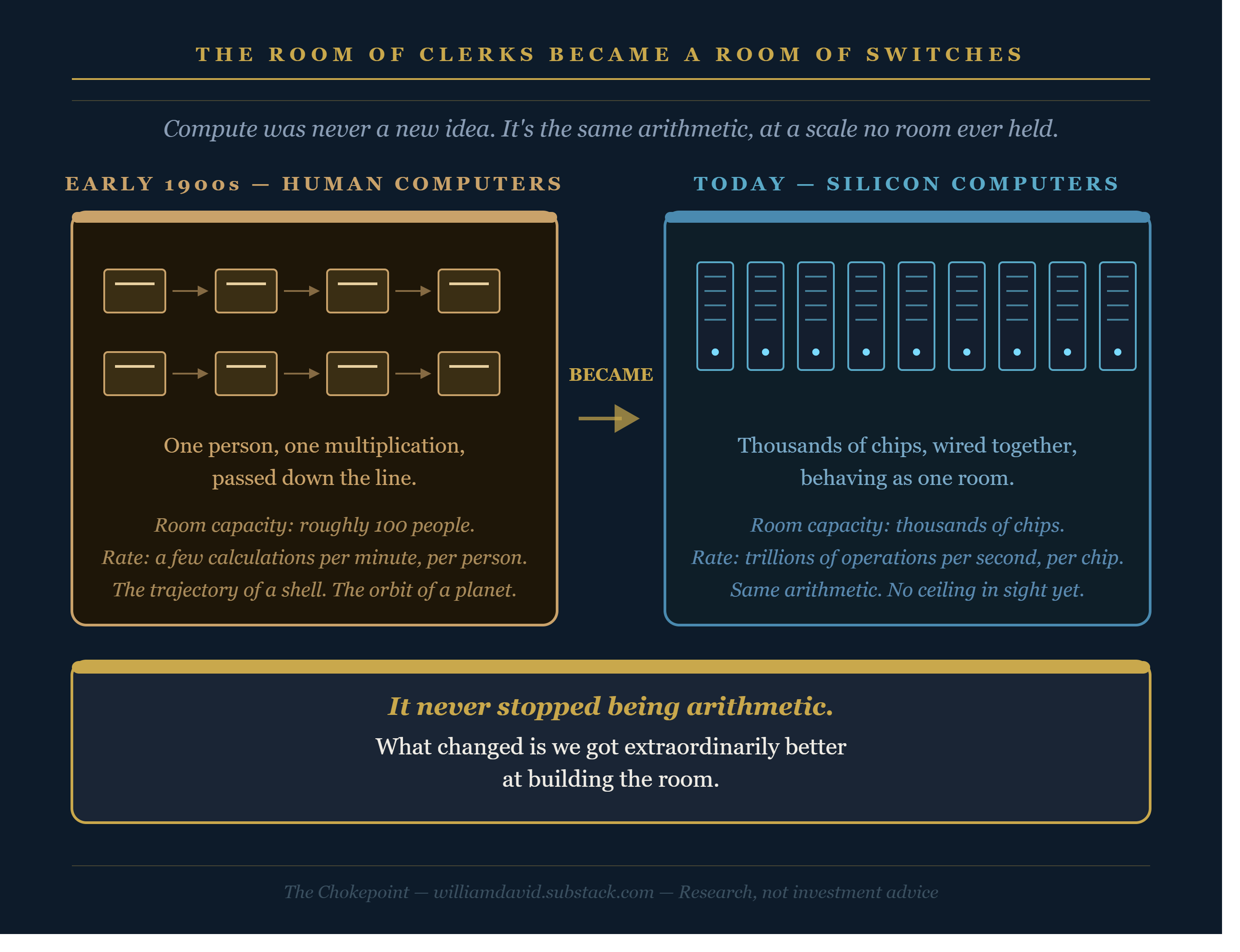
In the early twentieth century, if a company or a government needed a hard calculation done - the trajectory of an artillery shell, the orbit of a planet - they didn’t reach for a machine. They hired a room full of people, often women, and gave each of them one small piece of a much larger sum. One person multiplied two numbers, wrote the result on a slip of paper, and passed it down the line. The next person did the next step. Hour after hour, a room full of clerks turned an impossibly large calculation into a thousand small, boring ones.
That’s compute. It’s arithmetic, repeated, at whatever scale the problem demands. It never stopped being that. What changed is we got extraordinarily better at building the room.
Why this should already feel like your problem
If you’ve never thought about compute before today, that’s a reasonable place to have been. It happens somewhere else, on machines you’ll never see, and it’s easy to assume it stays there.
It doesn’t anymore. The room full of clerks scaled into the single largest capital allocation decision happening anywhere in the world right now - trillions of dollars, and the decision about how much of it gets built runs through boardrooms, not physics labs. If you hold an index fund, a meaningful share of it is a bet on how much arithmetic capacity a handful of companies can build, finance, and keep running. If your electricity bill has moved this year, some of that is this too. You don’t have to work in AI, or even like it, for this to already be your problem. It already is - and understanding what compute actually is comes first.
From a room of people to a room of switches
Modern compute happens inside a chip: a piece of silicon covered in billions of tiny switches (transistors) that flip on and off, incredibly fast, to do arithmetic. One switch flipping is one tiny step in a calculation - not so different, in principle, from one clerk doing one multiplication. The difference is scale and speed. A modern chip can perform billions, and in many cases trillions, of these steps every second. And where the clerks’ room topped out at maybe a hundred people working side by side, a modern data center runs thousands of these chips together, wired so tightly that they behave as one enormous room of arithmetic rather than thousands of separate ones.
That rate - how many operations a chip can do in a second - is usually measured in something called FLOPS (floating-point operations per second; “floating-point” just means the kind of number the arithmetic is done with, and you can safely ignore the detail). You’ll see chips advertised by their FLOPS the way a car is advertised by its horsepower. It’s not the whole story of what a chip can do, but it’s the number everyone reaches for first, because it answers the most basic question: how much arithmetic can this thing do per second if you point it at a problem?
Why AI needs so much of it
Training an AI model - teaching it through a huge number of examples about how language works, or how to recognize an image - is millions of these small calculations adjusted and repeated, over and over, until the model gets better at the task. Running the model afterward (what’s called inference, generating an answer to something you’ve asked it) is the same kind of arithmetic, just less of it per question.
Here’s the part that explains why this accelerated so fast. Each new generation of AI model has needed dramatically more of this arithmetic than the one before it, largely because bigger models, trained on more examples, have kept getting meaningfully better at the task - with no clear ceiling yet in sight. Nobody fully predicted (even a few years ago) how steep that curve would turn out to be. That’s how a technology built on simple, repeated arithmetic became the reason companies are now spending more on infrastructure than almost anything else in the economy.
Two companion pieces to this one, the AI Hardware Primer and the AI Memory Primer, go deep on the chip itself and on the memory that has to sit beside it feeding it data fast enough to keep up. This piece isn’t trying to repeat that ground. What matters here is simpler: AI is, underneath everything, an enormous, sustained demand for exactly the kind of repeated arithmetic a room full of clerks used to do by hand - just at a scale no room, and until recently no machine, could actually deliver.
The turn: compute becoming a commodity in itself
Here’s where this gets interesting, and where most explanations of AI infrastructure stop short.
Once you can measure a rate of arithmetic reliably, and once a company can promise to deliver that rate to a customer for months or years at a time, that promise starts to behave like anything else you can meter, sell, and contract in advance: electricity, natural gas, freight capacity. Nobody’s shipping you the electrons; they’re selling you a guaranteed rate, sustained over time, and you pay for it whether or not you use every unit.
Compute has started working the same way. A company like CoreWeave doesn’t sell chips - it sells access to a rate of computation, under contract, for a set period. Think of it less like buying a car and more like reserving GPU-hours: a customer locks in a certain amount of computing capacity, at a certain level of performance, for a certain stretch of time, the way a factory might reserve electricity in advance, or a retailer might reserve cargo space on a ship. And once that contracted rate is reliable enough, it becomes something else again: an asset a lender will finance against, the same way a bank will lend against a signed, long-term power contract before a single kilowatt has been delivered.
That’s not theoretical. In 2023, CoreWeave borrowed against its GPUs at a floating rate around 15 percent - the kind of rate lenders charge when the collateral is unfamiliar and the risk is hard to price. By early 2026, a comparable facility, this time for $8.5 billion, secured directly against its own fleet of chips and a long-term customer contract, priced at roughly a third of that and carried an investment-grade rating. Same basic collateral. Three years apart. That compression is the market deciding this asset class is real. It’s part of a fast-growing category: JPMorgan thinks this kind of financing could reach $30 to $40 billion a year through 2027, up from about $27 billion in 2025. Worth being precise about what that number actually covers, though - it's not GPU-backed debt specifically, it's the broader category that debt sits inside.
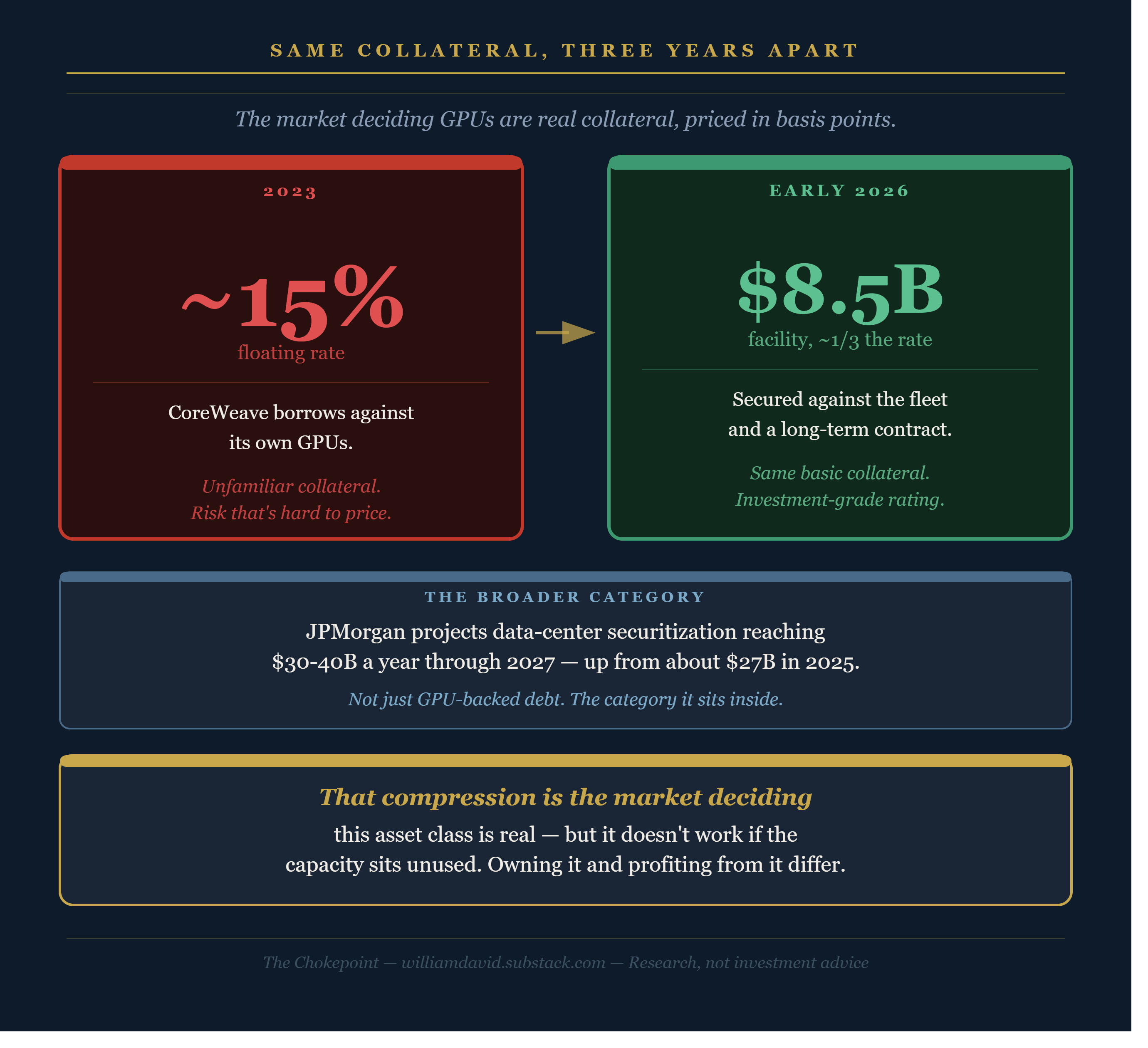
None of that works, though, if the capacity sits unused. A reserved GPU-hour that nobody runs a workload on costs exactly as much to finance as one running at full tilt, and earns nothing. That’s utilization - how much of a company’s installed compute is actually doing work at any given moment - and it’s one of the quiet numbers everyone financing this pays close attention to. Installed capacity and productive capacity aren’t the same thing, and the whole commodity argument only holds up as long as that gap stays small. Owning the hardware and profiting from it turn out to be two different skills.
One catch is worth being upfront about. Compute isn’t a perfectly interchangeable commodity yet, not the way a barrel of oil is. Two hours on one company’s chips can produce meaningfully more, or less, useful work than two hours on another’s, depending on the memory attached, the network connecting the chips together, and how reliably the whole system stays running. The commodity is emerging underneath those differences. It isn’t fully standardized yet, and that gap is exactly why financing it is still being figured out in real time rather than settled.
None of that changes the direction of travel. Compute isn’t just running AI anymore. It’s beginning to behave like an asset class of its own, with its own financing, its own contracts, and, increasingly, its own market price.
One honest complication
All of this rests on an assumption worth naming plainly: that a chip generating value today will still be worth something close to that a year or two from now. That assumption isn’t settled, and serious, well-resourced people disagree about it.
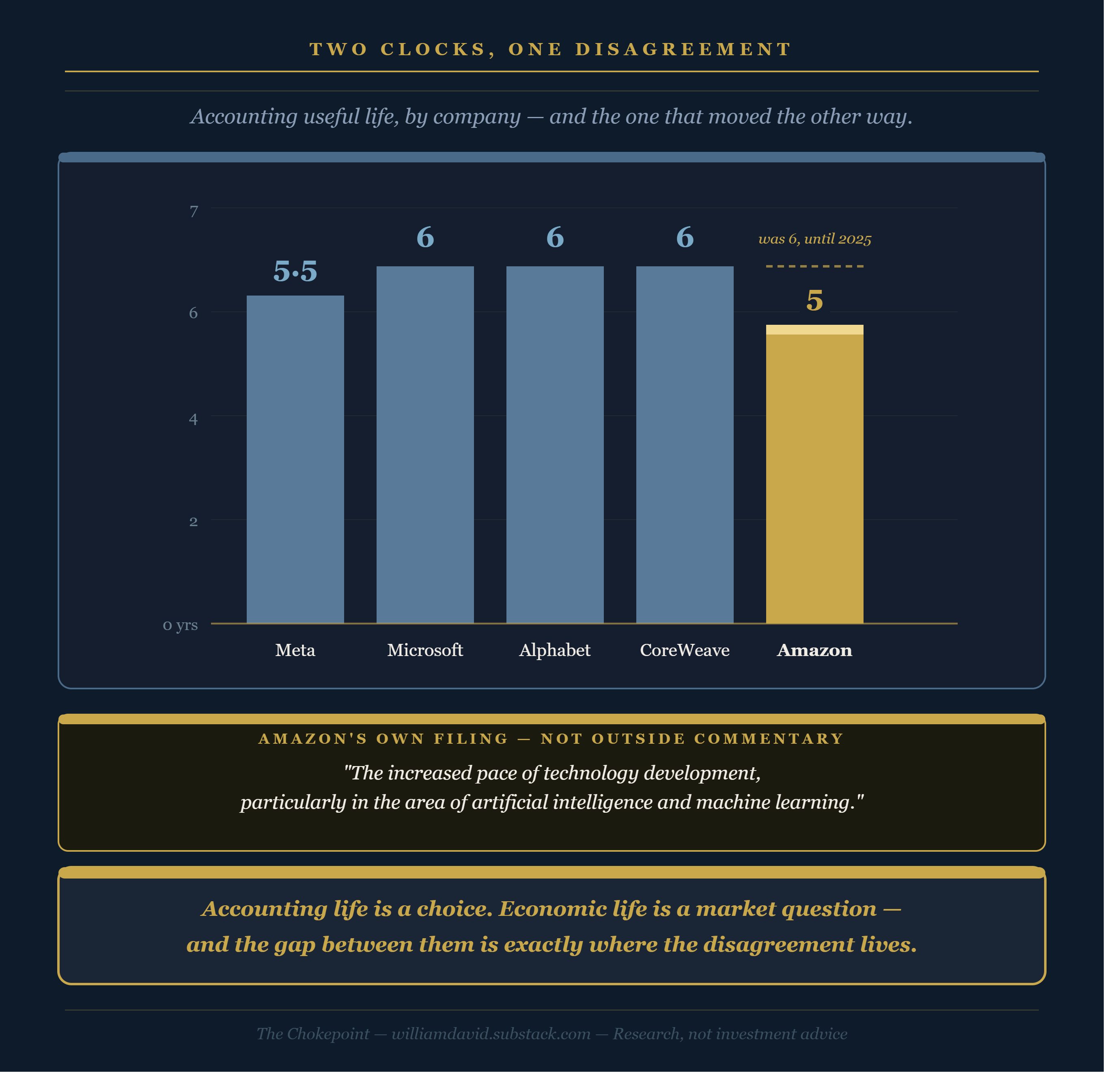
It helps to separate two different clocks here, because coverage of this tends to blend them together. One is accounting useful life: how many years a company spreads a chip’s cost over on its own books, for accounting purposes. Meta uses five and a half years. Microsoft, Alphabet, and CoreWeave still use six. Amazon uses five - and its case is particularly interesting, because it’s the one hyperscaler that moved the opposite direction. It ran six years too, until 2025, when it shortened its own estimate and said why in its own filing: “the increased pace of technology development, particularly in the area of artificial intelligence and machine learning.” That’s not outside commentary. That’s one company’s own accounting team formally taking a side in the argument this section is about. The other clock is economic life: how long that chip actually keeps earning real money before a newer, faster chip makes it uncompetitive. Those two clocks don’t have to agree, and the gap between them is exactly where the disagreement lives.
An older chip doesn’t become useless the moment a faster one ships, though. What determines whether it’s still worth running is the workload, not its age. A model that needs the newest chip to train doesn’t necessarily need it to run afterward, and a chip too slow for one job can be perfectly adequate for another. What actually decides this: whether the software still supports the older chip, whether it has enough memory for the job at hand, how much electricity it burns per unit of useful work, and how heavily it’s actually being used. That’s why older racks tend to migrate downward through the workload stack rather than getting scrapped, the way an old company car goes from the sales team racing between meetings to a less demanding job. Still useful, just not for the job it started with.
If a rack can stay useful for two or three more years this way, an operator can meet more of its growing compute needs without buying new hardware immediately - the installed base doesn’t vanish every time the next generation ships. But that only holds while the economics still make sense. Once electricity cost per unit of work gets too high, memory can’t fit the job anymore, the software stops being maintained, or the cost of keeping it running simply exceeds what its output is worth, it becomes a genuine write-off rather than a hand-me-down. Whether an old chip finds a home depends on the same kind of arithmetic the whole piece has been building toward: is this thing still doing useful work for what it costs to keep it running.
That tension is the real argument underneath the financing. Lenders put the resale value of a three-year-old chip anywhere from 10 percent to 60 percent of what it originally cost - an enormous range to build a loan around. Tiering pushes toward the higher end: a chip still doing useful work somewhere in the stack is worth something real. The gap between accounting life and economic life pushes toward the lower end: a chip can look fine on the books while the market has already decided nobody wants to pay full price for its output. Some of today’s strong demand for older chips may also be a temporary bridge rather than a permanent floor - the newest generation of chip can’t physically fit into most of the older data centers built to hold the last one, so the old chips are earning their keep by default, not necessarily because anyone still wants them for their own sake. Untangling how much of today’s resale value is genuine tiering demand versus that kind of bridge is exactly what lenders disagree about.
None of that means the reframing is wrong. It means the financing question isn’t really how long the books say a chip lasts. It’s what someone will still pay for that chip’s computing capacity once a newer generation exists - and right now, even the people financing this at scale don’t fully agree on the answer.
Why this matters, again
This has a practical edge, if you’re reading a company’s results with any of this in mind. “Exposure to AI” isn’t really a category worth much on its own. Two companies can both call themselves AI companies and mean completely different things by it - one owns compute that depreciates, competes on price, and needs constant reinvestment just to stay useful; another sells something scarce that goes into everyone else’s compute, with a backlog and no need to chase the next generation just to keep up. Only one of those companies is necessarily well positioned in what’s actually being built. And it’s worth remembering that even once compute genuinely does become commonplace, the scarcity behind it doesn’t disappear. It just moves - to memory, to power, to whatever the next layer down turns out to be the one nobody can build fast enough.
Compute used to be a cost of doing business: you bought the machine, you ran your calculation, the machine slowly became worth less. What’s happening now is different. A contracted, reliable rate of arithmetic has started to look, to the people who finance things for a living, like something closer to a commodity: metered, sold forward, borrowed against.
That shift is the thing sitting underneath almost everything written about AI infrastructure spending, financing, and the companies caught in the middle of it - even when it’s never said out loud. Understanding it doesn’t require an engineering background, or a finance background. It just requires seeing compute for what it actually is: a room full of arithmetic, scaled up past anything a room of people could ever do, that the market has started treating like something you can own a piece of.
Two companion pieces to this one, the AI Hardware Primer and the AI Memory Primer, go deep on the chip itself and on the memory that has to sit beside it feeding it data fast enough to keep up:
The AI Hardware Primer

Nvidia is down. The frontier labs are heading toward public markets at eye-watering valuations. A Chinese AI lab just released a model that rivals the best American ones at a fraction of the cost. If you’re trying to make sense of what’s happening - and what it means for where to put capital - most of what you’ve read hasn’t explained the part that actu…
Financial data sourced from company disclosures and JPMorgan research as of August 2026.
This post is for informational purposes only and is not investment advice. The Chokepoint is an independent investment research publication. Nothing in this publication should be construed as a recommendation to buy, sell, or hold any security. All company references and price data are provided for informational and contextual purposes only. Conduct independent due diligence and consult a qualified financial advisor before making any investment decisions.
The full archive is at williamdavid.substack.com.